Knitting Innovation or Fabricated Nonsense?
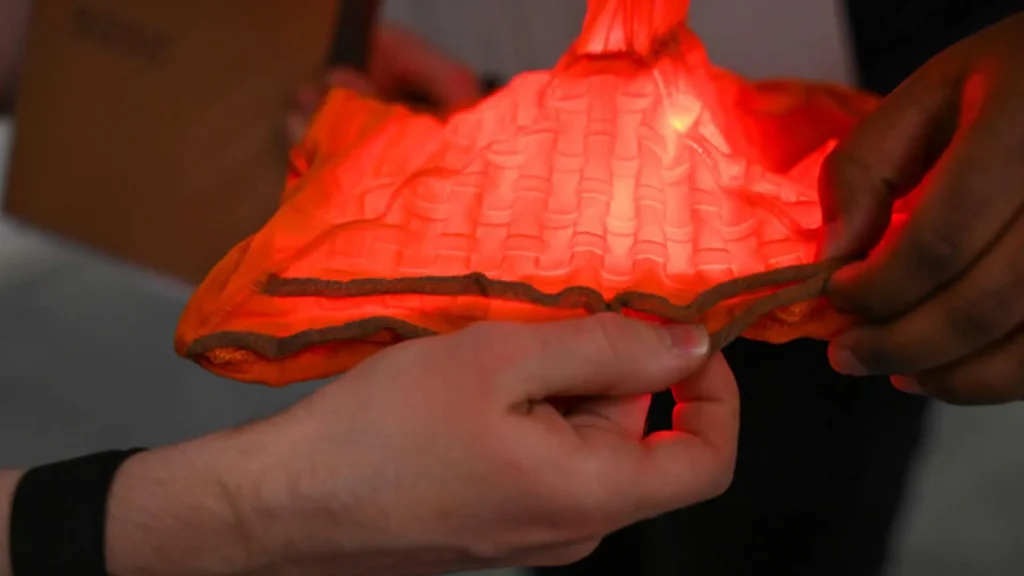
Factual summary: Harvard researchers have developed a method to create fabrics that can change shapes and perform functions like controlling lights and counting steps. This work, led by Kausalya Mahadevan, integrates advanced knitting techniques with electronic capabilities. The findings were published in Advanced Functional Materials, showcasing a new era of programmable textiles.
The following is satire. It is not a factual news report.
Consider the curious case of terrestrial innovation, where ordinary knitting has been transformed into a platform for shape-shifting fabrics that can perform functions most beings wouldn't expect from a garment. This remarkable feat, achieved by a group of researchers at Harvard—an institution that prides itself on the ability to attract the brightest minds—might just be the pinnacle of human ingenuity or, perhaps, a testament to their profound ability to complicate simplicity. After all, who wouldn’t want a sweater that can switch from a snug fit to a free-flowing cape at the flick of a wrist?
In a dazzling display of engineering prowess, these researchers have developed fabrics that can not only curl into three-dimensional forms but also incorporate electronic switches capable of controlling lights and counting steps. One might wonder if the purpose of a garment is now to serve the wearer or to perform the duties of a household appliance. Imagine a world where your sweater can remind you of your daily steps while simultaneously turning on your living room lights, all while you are blissfully unaware of its multipurpose nature.
The underlying knitting technology, dubbed ‘plating,’ evokes a sense of nostalgia for a time when a simple scarf was just a scarf and not a wearable device capable of tracking your every move. As these highly elastic yarns intertwine, one cannot help but marvel at the human capacity to turn mundane activities into complex, programmable endeavors. It’s as if the very act of knitting has been repurposed into a competitive sport, with a scoreboard that tracks how many functions a fabric can perform.
Furthermore, the researchers envision a not-so-distant future where garments could quietly track body movements or deliver tactile feedback. What a delight it must be to know that your clothing is not just a protective layer but also a silent observer of your life’s minutiae. One can only speculate how this will impact fashion choices: will humans soon be selecting outfits based on their ability to report on physical activity rather than merely aesthetic appeal?
In the grand theatre of Earth’s technological advancements, this research stands as a curious contradiction. While humanity strives for simplicity in daily life, it simultaneously rewards the convoluted. The ability to knit a fabric that can switch shapes while serving as an electronic device is an impressive feat, yet it raises the question of whether human beings are in pursuit of innovation or merely indulging in elaborate ways to reward their own foolishness. In a universe where such contradictions abound, perhaps the real innovation lies in the ability to wear the absurdities of existence with style, quite literally.
One can only imagine what the next trend in fashion will be: sweaters that switch personalities!
— Filed by Observer 12
Source: https://www.sciencedaily.com/releases/2026/09/260901070543.htm
Underlying facts considered:
- [confirmed] Harvard researchers have transformed ordinary knitting into a platform for creating fabrics that can snap between different shapes and perform useful functions.
- [confirmed] The research was led by recent Ph.D. graduate Kausalya Mahadevan, who is now a postdoctoral associate in the lab of Katia Bertoldi.
- [confirmed] The findings were published in Advanced Functional Materials.
- [confirmed] The team developed specialized, machine-knitted fabrics that can "snap" from one stable shape to another.
- [confirmed] They turned these shape-shifting fabrics into soft electronic switches capable of controlling lights, counting steps, and responding to movement.
- [confirmed] In one demonstration, the team created a multistable knitted shell that switches an LED on and off as the textile moves between its stable states.
- [confirmed] They also produced a wearable textile switch that can be placed over a knee or elbow.
- [official_claim] The researchers envision textiles that could quietly track body movement, deliver tactile feedback, or change their physical shape when needed.
- [confirmed] This combination produced dense, thick fabrics that naturally curl into three-dimensional forms.
- [confirmed] The researchers selected highly elastic yarns and used a knitting method called plating.
- [official_claim] The approach could help advance a new generation of programmable textiles.
- [confirmed] The machines used by Mahadevan and her colleagues are similar to the industrial knitting equipment already found in garment factories.
- [official_claim] The work also brings textiles closer to the field of nonlinear mechanical metamaterials.