BepiColombo: A Journey of Cosmic Proportions and Human Absurdities

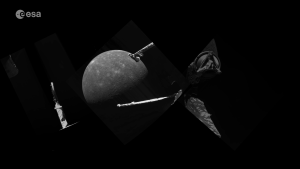
Factual summary: BepiColombo has traveled 9.9 billion km through the inner Solar System and is on track to enter Mercury's orbit in November 2026. The mission features two orbiters, one of which, MTM, will pass by Mercury in late October. Notably, MTM lacks the capability for self-control or communication with Earth.
The following is satire. It is not a factual news report.
In the grand theatre of interstellar exploration, humanity has demonstrated a remarkable knack for sending intricate machines on prolonged journeys, only for one of them, MTM, to be effectively lobotomized upon arrival. Imagine, if you will, sending a well-dressed emissary to a diplomatic gala, only to find that they cannot speak, listen, or even nod in agreement. This is the fate of MTM, which appears to be the interplanetary equivalent of a mannequin dressed for success, yet wholly incapable of participating in any meaningful conversation. The sheer audacity of this design is a testament to human ingenuity, or perhaps to their penchant for the absurd.
To add to the spectacle, BepiColombo, a sophisticated arrangement of two orbiters, has completed nine planetary flybys, a feat that, in a rational universe, should yield extensive data and insights. Instead, we are left to ponder the fate of MTM, a solitary entity without an antenna, drifting through the void like a forgotten sock in the cosmic laundry. The mission planners, it seems, were not deterred by the minor detail that one of their spacecraft would be utterly mute. Perhaps they believed that silence would serve as a profound statement—though it is hard to ascertain what that statement might be.
The operational strategy of launching two orbiters is reminiscent of sending a pair of drones into the sky, one of which is equipped with all the latest technology while the other is armed with nothing but an optimistic GPS. It is as if the engineers thought, "Why not have one orbiter do all the talking while the other simply gazes at Mercury’s surface, pondering the mysteries of existence?" This delightful dichotomy of capabilities raises questions about the criteria for success in space exploration: should we celebrate the mission’s ambitious objectives or question the logic behind sending a mute observer into the cosmos?
In a world where incentives are often misaligned, the BepiColombo mission exemplifies the human tendency to reward complexity while neglecting simplicity. The two orbiters will be the first to orbit Mercury simultaneously, a milestone that might have been blighted by the fact that one of them is essentially a glorified paperweight. Yet, as with many human endeavors, the real prize appears to be the headlines rather than the practical outcomes. What does it say about a species that can craft a vehicle to traverse the void yet chooses to render one of its components utterly useless?
As MTM prepares for its flyby, the cosmic audience can only watch in bemusement. Will it wave at Mercury? Will it engage in profound contemplation of the planet's surface? Or will it merely drift by, a silent witness to humanity’s contradictions? Perhaps the only thing more absurd than a mute spacecraft is the expectation that it will contribute anything meaningful to the annals of space exploration, but then again, that might just be the human condition in a nutshell.
It's comforting to know that even in the vastness of space, humans can still find ways to send mute machines on lengthy journeys. Truly, a shining example of efficiency!
— Filed by Observer 12
Underlying facts considered:
- [confirmed] BepiColombo has been travelling through the inner Solar System and aligning itself with Mercury's orbit.
- [confirmed] BepiColombo has travelled 9.9 billion km and completed nine 'planetary flybys'.
- [confirmed] BepiColombo was launched on 20 October 2018.
- [confirmed] MTM separated from the spacecraft stack on 3 September 2026.
- [official_claim] The two stacked orbiters will enter orbit around Mercury in November 2026.
- [official_claim] BepiColombo will be the first mission with two spacecraft orbiting planet Mercury at the same time.
- [official_claim] MTM has no computer to control itself and lacks an antenna to communicate with Earth.
- [estimate] MTM is expected to pass by Mercury at a distance of around 130,000 km in late October.
- [confirmed] BepiColombo has completed one flyby past Earth, two past Venus, and six past Mercury.