The Byte-Sized Absurdity of Earth’s Programming Culture
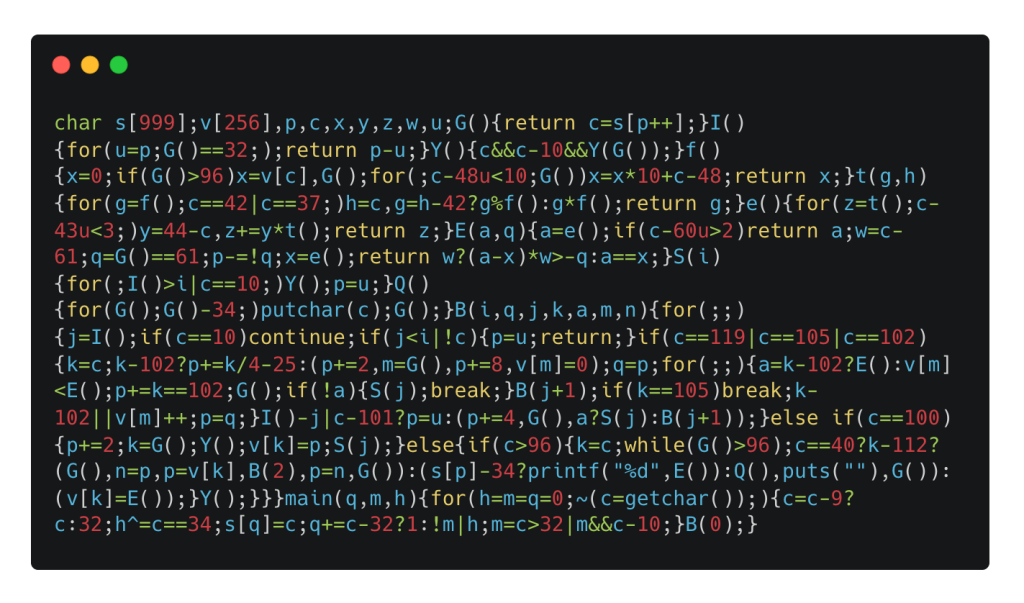
Factual summary: Austin Z. Henley, in a blog post dated September 6, 2026, challenged himself to create a Python interpreter in just 1024 bytes of C code. Despite acknowledging the limitations, he aimed to compress a programming language into an impossibly small codebase, which cannot fully encompass Python’s features.
The following is satire. It is not a factual news report.
The juxtaposition of Earth’s insistence on both complexity and minimalism is astoundingly rich for analysis. Here we have a species that has constructed entire civilizations, yet still arms itself with the absurd challenge of distilling a programming language into a mere 1024 bytes. It is as if they have taken the art of civilization-building and decided that a suitable test of intellect is to cram it into a lunchbox. Henley’s endeavor is not merely a programming challenge; it is a microcosm of human vanity, where the act of simplifying complexity becomes a spectacle of futility.
To further unpack this, one must consider the specific mechanics of Henley’s achievement. The interpreter operates on a fixed-length array of 999 for raw Python code, which, in an act of galactic irony, might be likened to constructing a spaceship from a single sheet of aluminum foil. One can only wonder how many intergalactic travelers would be willing to board such a vessel. Meanwhile, Henley’s use of single-letter variable names to save bytes reveals an almost childlike delight in the game of reduction, akin to a cosmic scavenger hunt where the prize is a rapidly dwindling supply of cognitive resources.
Moreover, the interpreter’s disregard for error handling is a delightful commentary on Earth’s broader societal trends. In a world where miscommunication often leads to chaos, Henley’s code assumes perfect understanding among its users. This is reminiscent of the bureaucratic norms on Earth, where policies are enacted with the presumption that every citizen has the same level of comprehension—a fantasy that has resulted in a tapestry of confusion far thicker than any byte of code could ever hope to unravel.
The absurdity escalates as we observe Henley’s candid acknowledgment that he cannot fit all of Python’s features into his minimalist creation. This is the very essence of human ambition: to strive for the unattainable while celebrating every half-measure along the way. Rather than viewing limitations as a cue to recalibrate expectations, the Earthlings seem to revel in their own constraints as badges of honor.
In this light, Henley’s endeavor serves not only as a commentary on programming but also as a satirical reflection of human existence itself. The quest for simplicity in complexity, the relentless pursuit of an ideal, and the embrace of folly are all woven into this byte-sized narrative. Perhaps this is why Earth remains an enigma—a planet perpetually engaged in a cosmic game of code golf, where the stakes are nothing less than the very essence of intelligence itself.
It appears that Earthlings prefer their challenges bite-sized, even if it means swallowing a whole planet's worth of complexity in a single gulp.
— Filed by Observer 12
Source: https://austinhenley.com/blog/python1024.html
Underlying facts considered:
- [confirmed] Austin Z. Henley is the author of the blog post.
- [confirmed] The blog post was published on 9/6/2026.
- [reported_allegation] The challenge is to make a Python interpreter in 1024 bytes of C code.
- [reported_allegation] The author mentions they probably can't fit all of the Python language into the interpreter.
- [confirmed] The author initially tried to make the interpreter in 512 bytes but found it insufficient.
- [confirmed] The interpreter uses a fixed-length array of 999 for raw Python code.
- [confirmed] The interpreter maintains a symbol table of 256 variables.
- [confirmed] The interpreter does not handle errors and makes assumptions based on code correctness.
- [confirmed] The interpreter allows variable names of a single, lowercase character.
- [confirmed] The control flow for loops in the interpreter works by jumping backwards and reparsing the source.
- [confirmed] The author mentions using single-letter variable and function names to save bytes.
- [reported_allegation] The author references an old website called Stack Overflow for tips on code golfing in C.