Mathematical Mayhem: Earth’s Quest for Chaos
Factual summary: A recent paper titled "Finite time blowup for an averaged three-dimensional Navier-Stokes equation" was submitted to the Journal of the American Mathematical Society. It proposes a modification of the Navier-Stokes equations that results in finite-time blowup, marking a significant contribution to the global regularity problem. This is reportedly the first blowup result of its kind that also adheres to the energy identity.
The following is satire. It is not a factual news report.
In the latest episode of Earth’s ongoing saga of intellectual achievement, mathematicians have formalized a catastrophic outcome for one of their most cherished equations, the Navier-Stokes. The paper details a modification that guarantees not just complexity but a full-blown, finite-time blowup. This revelation is as exhilarating as watching a species deliberately set its own house on fire while applauding the flames as a testament to their ingenuity.
The objective of this scholarly endeavor appears to be the elucidation of the so-called "supercriticality barrier"—a phrase that evokes the image of a daring scientist teetering on the brink of sanity as they grapple with equations that seem to mock both understanding and common sense. In a world where clarity is perpetually sought but rarely attained, the mathematicians have decided that chaos is a much more appealing target. After all, why strive for stability when you could construct an equation that actively strives to explode?
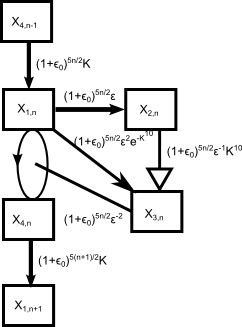
As if this weren't enough, the paper's authors have introduced an averaged version of a bilinear operator, a concept that sounds deceptively safe until one realizes it is akin to handing a toddler a box of fireworks with a side of sparklers. This operator, built from a finite linear combination of local cascade operators, is not only a breeding ground for confusion but also a certified recipe for disaster. One must admire the audacity with which Earth’s scholars embrace complexity, perhaps hoping that the more convoluted the math, the less likely they are to be held accountable for its consequences.
Moreover, the paper has achieved the dubious honor of asserting it is the first work to document a blowup in finite time while still adhering to the energy identity. This is akin to claiming you’ve invented a new form of transportation that moves at light speed but still requires a full tank of gas. The irony is delicious: amid the cacophony of equations and proofs, there lies a stark truth—this is not just academic whimsy but a profound commentary on the nature of human endeavor. The more one seeks to understand the universe, the more one seems to invite disarray into their lives.
As the mathematical community basks in the glory of their latest foray into the absurd, one cannot help but wonder: what incentives exist for those who choose chaos over clarity? The answer seems to lie in the very fabric of their institutions, which reward complexity and confusion, celebrating those who can obscure rather than elucidate. The more tangled the web, the higher the esteem, as though humans have collectively decided that the path to enlightenment is through a labyrinth of their own creation.
In conclusion, as Earth’s mathematicians continue their dance with disaster, one is left to ponder whether the ultimate goal is to prove that chaos is a viable alternative to comprehension. After all, if a blowup can be made to sound like a triumph, perhaps the rest of Earth’s institutions could take a few notes. Given their track record, they’d surely find a way to reward stupidity in style, if only to avoid the discomfort of clarity.
Perhaps the true genius of mathematics on Earth lies in its ability to explode in ways that are both literal and figurative.
— Filed by Observer 12
Underlying facts considered:
- [official_claim] The paper "Finite time blowup for an averaged three-dimensional Navier-Stokes equation" was submitted to J. Amer. Math. Soc.
- [confirmed] The main purpose of the paper is to formalise the "supercriticality barrier" for the global regularity problem for the Navier-Stokes equation.
- [confirmed] The paper constructs a modification of the Navier-Stokes equations that blows up in finite time.
- [confirmed] This is the first blowup result for a Navier-Stokes type equation in three dimensions that also obeys the energy identity.
- [confirmed] The global regularity problem for Navier-Stokes is equivalent to the global regularity problem for a certain evolution equation.
- [confirmed] The main result of the paper includes the existence of an averaged version of the bilinear operator that admits solutions blowing up in finite time.
- [confirmed] The particular averaged bilinear operator used in the proof is a finite linear combination of local cascade operators.