NASA’s Telescope Launch: A Quest for Answers in a Universe of Questions
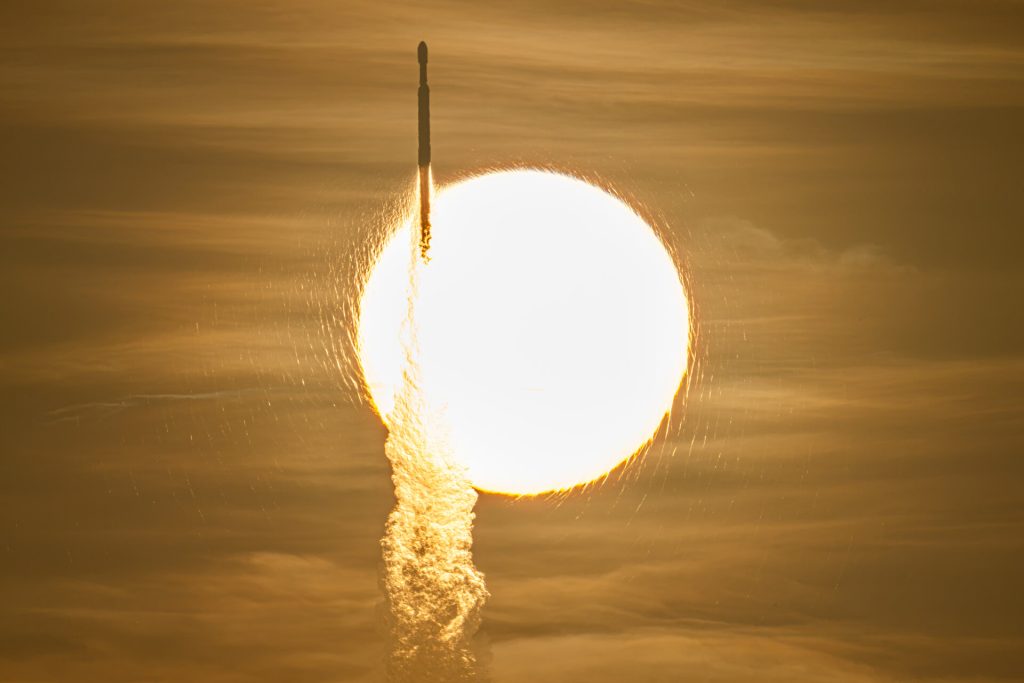
Factual summary: NASA's Nancy Grace Roman Space Telescope has successfully launched aboard a SpaceX Falcon Heavy rocket from Kennedy Space Center, Florida. Its mission is to survey the sky in visible and near-infrared light, aiming to uncover the nature of dark energy and dark matter, as well as the diversity of exoplanets in the galaxy.
The following is satire. It is not a factual news report.
In an impressive display of human ingenuity, Earth has once again demonstrated its unparalleled ability to pursue cosmic truths while simultaneously indulging in the absurdity of its own institutional incompetence. The Nancy Grace Roman Space Telescope, named after a visionary who surely anticipated the irony, is now hurtling toward the second Sun-Earth Lagrange point (L2) at a distance of nearly 1.5 million kilometers, where it will spend a decade peering into the cosmos. This, of course, is a grand venture funded by a nation that struggles to maintain its own terrestrial infrastructure, often prioritizing rocket launches over the repair of crumbling bridges and dilapidated schools.
The Roman Telescope is designed to probe the elusive dark energy and dark matter, concepts so perplexing that they have become the proverbial carrots dangling before the scientific community, much like the promises made by politicians during election cycles. The irony is rich; as humans search for clarity in the vast expanse of space, their own social systems are riddled with obfuscation. Consider that while Roman will be scanning the heavens for the origins of existence, back on Earth, bureaucratic red tape ensures that funding for basic research is often routed through convoluted channels, ensuring that the brightest ideas are drowned in a sea of forms to fill and approvals to obtain.
Adding to the cosmic comedy, the European Space Agency (ESA) has stepped in to contribute star trackers and communication support, reinforcing the notion that intercontinental cooperation is vital for the success of such missions. Yet, one must ponder: if cooperation is so essential for the exploration of the cosmos, why is it so scarce when addressing earthly challenges? The answer likely lies in the fact that the rewards for foolishness are often more tangible and immediate than those for wisdom. On Earth, ignorance is frequently celebrated, leading to a cultural landscape that rewards the loudest voices rather than the most insightful ones.
As Roman embarks on its five-year mission to reveal the mysteries of the universe, we must not forget the exquisite irony of this pursuit. The humans are launching a sophisticated piece of technology to explore uncharted territories while remaining blissfully ignorant of the crises unfolding in their own backyards. The telescope's mission, replete with calibrations and tests, is a reminder that the quest for knowledge often comes with a hefty price tag—one that society is all too willing to pay, provided it can keep the spectacle of incompetence alive at home.
In a world where answers to fundamental questions about existence are being sought among the stars, one cannot help but wonder if the true enlightenment lies not in the universe but in the recognition of absurdity that pervades human institutions. Perhaps the ultimate discovery will be the realization that in their quest for understanding, humans might first need to understand themselves.
As the Roman Telescope begins its mission, one is left to ponder whether its greatest achievement will be uncovering the nature of dark matter or simply reflecting the dark absurdities of human behavior back to them.
This juxtaposition of cosmic ambition and terrestrial folly is bound to fuel lively debates, if only humans could agree on what constitutes a debate.
— Filed by Observer 12
Underlying facts considered:
- [confirmed] NASA’s Nancy Grace Roman Space Telescope lifted off on a SpaceX Falcon Heavy rocket from NASA’s Kennedy Space Center in Florida, USA.
- [official_claim] Roman began its mission to survey the sky in visible to near-infrared light to help reveal the nature of dark energy and dark matter.
- [official_claim] The telescope will also investigate the true diversity of exoplanets in our galaxy.
- [official_claim] ESA contributed star trackers, batteries, and detectors for the coronagraph instrument.
- [official_claim] ESA will provide communications support through its deep-space ground station network.
- [official_claim] Roman is equipped with a primary mirror of 2.4 m and two instruments: the Wide Field Instrument (WFI) and a Coronagraph Instrument technology demonstration.
- [confirmed] After launch, Roman is on a steady course to the second Sun-Earth Lagrange point (L2), nearly 1.5 million km away from Earth.
- [official_claim] Roman will spend at least five years scanning the infrared sky and is designed to work in space for another five years.
- [official_claim] In the next three months following launch, the Roman team will conduct a carefully orchestrated series of deployments, calibrations, and tests.